What we do
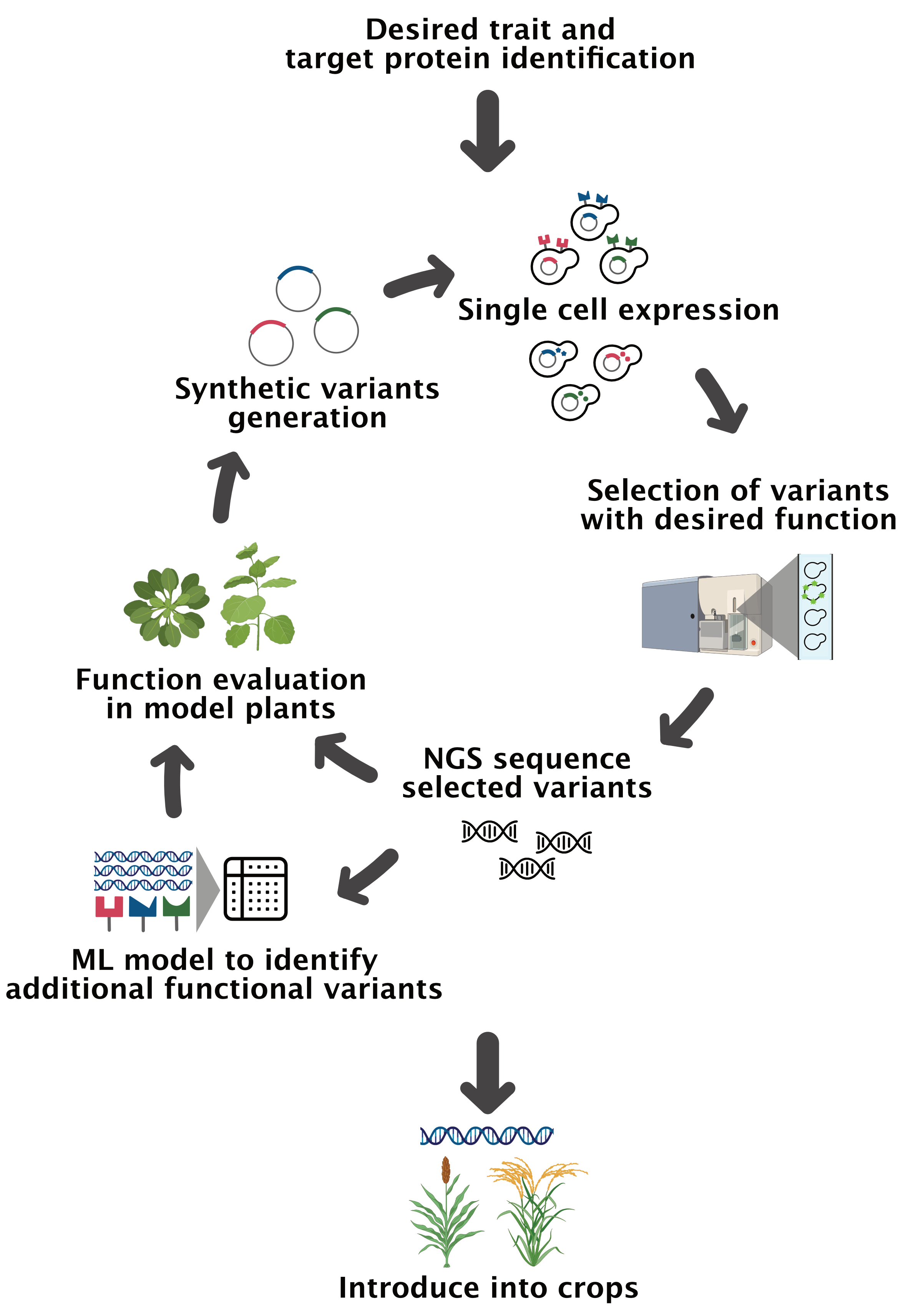
We begin with a specific need and identify key protein targets to address it. We engineer proteins using directed evolution – a synthetic biology approach that enables rapid development of protein variants with novel or enhanced functions. This approach allows us to 1) identify beneficial changes to crop proteins that can be introduced via gene editing and 2) generate large datasets to train machine learning models that can predict the function of additional protein variants.
We focus on
- Resistance to pathogens and pests
- Resilience to environmental stress
- Photosynthetic efficiency
Recent Publications
Full list on Google Scholar ↗
-
Shim Y, Rim E, Liao J, Cho M, Austin G, Carlos P, Kulkarni S, Payne R, Ercoli M, Ronald P. Signaling by a tyrosine-sulfated peptide balances growth and osmotic stress response in rice. Proceedings of the National Academy of Sciences. 2026.
-
Berlingeri J, Fuentes A, Ranario E, Yun H, Rim E, Garrett O, Howard A, LaPorte M, Lo S, Pauli D, et al. Integration of crop modeling and sensing into molecular breeding for nutritional quality and stress tolerance. Theoretical and Applied Genetics. 2025.
-
Rim E, Garrett O, Howard A, Shim Y, Li Y, Van Dyke J, Packer R, Ho N, Jain R, Stewart V, et al. Directed Evolution of a Plant Immune Receptor for Broad Spectrum Effector Recognition. bioRxiv. 2025.
-
Howard A, Rim E, Garrett O, Shim Y, Notwell J, Ronald P. Combining Directed Evolution with Machine Learning Enables Accurate Genotype-to-Phenotype Predictions. bioRxiv. 2025.
-
Ercoli M, Luu D, Rim E, Shigenaga A, Teixeira de Araujo A, Chern M, Jain R, Ruan R, Joe A, Stewart V, et al. Plant immunity: Rice XA21-mediated resistance to bacterial infection. Proceedings of the National Academy of Sciences. 2022.